


The Watsonville Riots (1930): When California Tried to Drive Filipinos Out
UGAT CLOTHING · HISTORY · Filipino American History Month Series
Post 10 · The Watsonville Riots (1930): When California Tried to Drive Filipinos Out
For five days in January 1930, white mobs armed with clubs and guns hunted Filipino farmworkers through the streets and fields of Watsonville, California. On the fifth night, they shot into a labor camp on San Juan Road. A 22-year-old farmworker named Fermin Tobera was killed as he slept. His murderer was never charged. His body was sent home to the Philippines, where tens of thousands mourned him in the streets of Manila. This is a story most Americans have never heard — and one that every Filipino American should know.
The 1930s are remembered as the decade of the Great Depression — of breadlines and bank failures, of Hoovervilles and dust bowls, of white Americans in desperate circumstances. What is less remembered is what that desperation did to the Filipino men working the fields of California: how quickly economic anxiety curdled into racial violence, how readily local officials reached for the language of invasion and contamination, and how completely the resulting attacks on Filipino workers were forgotten by the country that had encouraged those workers to come in the first place.
The Watsonville Riots of 1930 were the most explosive episode of anti-Filipino violence in American history. They were not a sudden outbreak. They were the culmination of years of mounting hostility — a pressure that had been building since the first Manong generation arrived in California's fields and refused, stubbornly, to disappear into invisibility the way the country expected them to.
Understanding what happened in Watsonville in January 1930 means understanding something essential about the Manong generation, about the immigrant experience, about racial violence in America — and about the extraordinary resilience of a community that survived it all.
Why Filipinos Were in California — and Why That Enraged People
After the Chinese Exclusion Act of 1882 and the Asiatic Barred Zone Act of 1917 cut off the supply of Chinese and Japanese agricultural labor, California's growers had a problem: their fields still needed workers, and white workers largely refused to do the backbreaking stoop labor that agriculture demanded. They turned to the Philippines.
Because the Philippines was an American territory — acquired from Spain in 1898 for $20 million after the Spanish-American War — Filipinos were classified as U.S. nationals. They could travel freely to the mainland. They could not be excluded by immigration law. And they could be recruited in massive numbers to fill the exact labor gap the growers needed filled.
Between 1920 and 1930, the Filipino population in the continental United States jumped from approximately 5,600 to more than 45,000. In California's Central Valley and coastal agricultural regions, Filipino men became the dominant workforce — cutting asparagus in Stockton, harvesting lettuce in Watsonville, picking grapes in Fresno, canning fish up and down the coast. They were indispensable to an industry worth hundreds of millions of dollars.
They were also, in virtually every other respect, unwelcome.
Filipino workers were paid the lowest wages of any ethnic group on California's farms — often less than $2 a day for ten-hour shifts. They were housed in the most overcrowded and deteriorated labor camps. They were barred from becoming citizens, from owning land, and in many counties from using the same public spaces as white residents. They existed in the same legal limbo that had defined Filipino life in America since 1898: necessary enough to import, foreign enough to exclude from full humanity.
But the Manongs refused to perform the role that had been assigned to them. They dressed well — saving money from their meager wages to buy fashionable clothes. They drove automobiles. They frequented pool halls and dance halls. They asserted themselves as human beings with the same desire for dignity, companionship, and social life as anyone else. And this — more than the economic competition, though that was real too — is what ignited the fury that culminated in Watsonville.
The Numbers Behind the Tension
📊 45,208 — Filipino population in the continental U.S. by 1930, up from 5,603 in 1920
👨 9 out of 10 Filipino immigrants were male, with an average age of 21 — creating a largely bachelor community with almost no Filipino women to partner with
💵 Less than $2 a day — the going wage for Filipino agricultural workers, below what any ethnic group was paid for comparable work
🚫 40:1 — approximate ratio of Filipino men to Filipino women in California, which drove Filipino men to seek companionship in taxi-dance halls and social settings where they might meet women of other backgrounds
⚖️ Legal status — U.S. nationals but not citizens: Filipinos could not vote, naturalize, own land, or marry white women under California's anti-miscegenation laws — yet could not be excluded from entering the country
Makibaka Collection · Delano Manongs Collection
The Manong generation worked the fields that fed this country, survived riots that tried to drive them out, and built the labor movement that changed California forever. UGAT honors their endurance.

Before Watsonville: Exeter, October 1929
The violence did not begin in Watsonville. It began in Exeter, in California's San Joaquin Valley, on the same day as the Wall Street Crash — October 24, 1929.
A group of Filipino men had escorted white women to an autumn street carnival celebrating the harvest of Thompson grapes. White men in the crowd pelted them with rubber bands. A fight broke out. A white man was stabbed. And then, rather than protecting public safety, the local police chief led a mob of 300 white vigilantes into the Filipino labor camp — where they beat and stoned farmworkers with farm tools. Approximately 50 Filipinos were injured. More than 200 were driven from the camp entirely.
The local newspaper, the Exeter Sun, blamed the Filipinos for their "penchant for violence." The Stockton Record deplored their "insistence that they be treated as equals by white girls." The framing was immediate and consistent: the violence was the fault of the people being attacked, for refusing to accept inferior status.
No one was prosecuted for the assault on the labor camp. The police chief who led the mob faced no consequences. And the template had been established: Filipino workers who asserted themselves socially — who walked beside white women at a carnival, who danced with white women at a dance hall, who dressed like men who had self-respect — could expect violence, and the violence would be justified by their own behavior.
The pressure continued to build through the fall and early winter. In December 1929, the North Monterey Chamber of Commerce publicly called for businesses to stop hiring Filipinos. A Watsonville newspaper ran a front-page photograph of Filipino immigrant Perfecto Bandalan embracing Esther Schmick, a 16-year-old white woman — framing it as scandal, suppressing the fact that the two were engaged to be married and that Bandalan was helping care for Esther's younger sister at her mother's request.
The community was primed. All it needed was a match.
Judge Rohrbach's Resolution: The Match That Started the Fire
On January 10, 1930, Judge D.W. Rohrbach — a Justice of the Peace in Watsonville — delivered a resolution at a Northern California Monterey Chamber of Commerce meeting. The text was printed in local newspapers the following day and spread through the community like an accelerant.
"For a wage that a white man cannot exist on, the Filipinos will take the job and, through the clannish, low standard mode of housing and feeding practiced among them, will soon be well clothed, and strutting about like a peacock and endeavoring to attract the eyes of the young American and Mexican girls."
— Judge D.W. Rohrbach, Justice of the Peace, Watsonville, January 10, 1930, as printed in the Evening Pajaronian
Rohrbach's resolution condemned Filipinos as an "economic and social menace" — simultaneously charging that they took jobs from white workers by accepting lower wages, and that they then used the money they saved to dress well, buy automobiles, and pursue relationships with white and Mexican women. The logical contradiction was invisible to his audience. Filipino men were dangerous whether they were poor or well-dressed, whether they stayed in their camps or entered social spaces, whether they worked or didn't.
The resolution called for Filipino deportation — for the United States to grant the Philippines independence so that Filipinos could be reclassified as foreigners and excluded. Rohrbach said he hoped "white people who have inherited this country for themselves and their offspring could live" without Filipino competition.
Within days, a new Filipino-owned taxi-dance hall opened near Palm Beach, west of Watsonville — a venue where young Filipino men could pay to dance with white women. The combination of Rohrbach's inflammatory speech and the dance hall's opening was more than enough. On the night of January 18, 1930, the riots began.
Five Days of Terror: January 19–23, 1930
What happened in Watsonville over the following five days was not a spontaneous outburst. It was organized, sustained, and escalating violence — and it happened with the tacit approval, and sometimes the active participation, of local law enforcement.
Jan 18–19
Near midnight, approximately 500 white men and youths gather outside the Filipino taxi-dance club in Palm Beach, armed with clubs. The building's Filipino owners and armed security hold them off and threaten to shoot. The mob disperses — temporarily. The following day, 300 Filipinos hold a public meeting to oppose Judge Rohrbach's statements and condemn local officials for inciting violence. The same day, white men begin picketing the dance hall.
Jan 20–22
200 armed white men search the streets and raid the dance hall over three days of continuous violence. Firefighters at one point turn their hoses on a mob to prevent the burning of a Filipino labor camp at the Firebaugh Ranch. Filipino workers are beaten on the streets and in their dormitories. Dozens are injured. Many flee.
Jan 22, night
The mob swells to 500. Armed men fan out to the farms and labor camps surrounding Watsonville, ransacking Filipino workers' homes and shooting into their dwellings. The violence moves out of town and into the countryside where Filipino workers live and sleep.
Jan 23, early morning
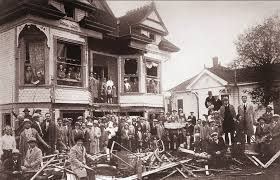
Eight white men drive to John Murphy Ranch on San Juan Road, where Filipino farmworkers are housed in a labor camp. They fire multiple rounds of shotgun blasts into the bunkhouse. Inside, workers have hidden in closets and under bunks. A single bullet finds Fermin Tobera, age 22, asleep in his bed. It passes through the wall and strikes him in the heart. He is killed instantly.
Jan 23, aftermath
The murder of Tobera ends the Watsonville riots. Sheriff Nick Sinnott, who had spent the preceding days gathering Filipinos and moving them out of the area for their "protection" rather than arresting the rioters, now faces national scrutiny. Eight men are eventually arrested for the broader rioting. Seven are convicted — they receive probation or 30 days in jail. No one is ever charged with the murder of Fermin Tobera.
The violence did not stay in Watsonville. In the days following Tobera's murder, riots spread to Stockton, San Francisco, San Jose, Salinas, and Gilroy. In Stockton, the clubhouse of the Filipino Federation of America was bombed — and local officials blamed the Filipinos themselves for the explosion. Armed groups, some organized like the Ku Klux Klan, began patrolling rural roads in the San Joaquin Valley, warning Filipinos to leave. Signs appeared in towns: Filipinos, get out.
"The worst part of the Filipino man being here is his mixing with young white girls. He gives them silk underwear and makes them pregnant and crowds whites out of jobs in the bargain."
— Local judge, quoted by the Equal Justice Initiative in coverage of the Watsonville Riots, January 1930

Fermin Tobera: The Martyr Manila Didn't Forget
Fermin Tobera was 22 years old. He had come to California from the Philippines to work — as hundreds of thousands of young Filipino men had done — in the agricultural fields of the American West. He was not a labor leader, not a public figure, not someone whose name would have been remembered by history if he had lived out a quiet working life in the fields of the Pajaro Valley. He was one of hundreds of young men sleeping in a labor camp bunkhouse on San Juan Road on the night of January 22, 1930.
The bullet that killed him changed everything.
When news of his murder reached the Philippines, the response was immediate and enormous. Demonstrations erupted in Manila and in cities across the islands. The question of Philippine-American relations — already tense, already complicated by decades of colonial rule and the memory of the Philippine-American War — was suddenly explosive. Here was a young Filipino man, working legally on American soil as a U.S. national, murdered by a white mob, with his killer walking free.
Tobera's body was shipped back to the Philippines, where it lay in state. He became a martyr — not just for the Filipino workers in California, but for the entire Philippine independence movement. His death gave new urgency to the question that had been building for years: if Filipinos were colonial subjects of the United States, subject to American law but denied American rights, what exactly was the relationship between these two countries?
The Philippine government declared a national day of humiliation in his honor. Filipino newspapers called him a symbol of American hypocrisy — a country that proclaimed freedom and democracy while allowing its colonial subjects to be murdered without consequences. His name was invoked in the Philippine legislature as politicians debated accelerating the timeline to independence.
The Consequences No One Faced
⚖️ Murder charge: None filed. Despite concrete leads and witness testimony, the men who fired into Tobera's bunkhouse were never indicted for his death.
🔒 Riot convictions: Seven men convicted for the broader rioting. Maximum sentence: one month in jail. Others received probation.
🚔 Police role: Rather than arresting rioters, Sheriff Sinnott's office focused on rounding up Filipino workers and moving them out of Watsonville for their "protection" — effectively punishing the victims.
🏛 Official response: Local officials who had delivered inflammatory anti-Filipino speeches in the days before the riots — including Judge Rohrbach — faced no legal or professional consequences.
📰 Press framing: Most local newspapers framed the riots as caused by Filipino workers' behavior, not by the mobs who attacked them. The Evening Pajaronian, which had printed Rohrbach's incendiary resolution, published coverage that portrayed Filipino workers as the provocateurs of their own persecution.
The Filipino Response: The Torch Burns Back
While the mobs were rioting and the newspapers were justifying the violence, Filipino workers and community leaders in the Pajaro Valley and across California were not silent.
Filipinos in nearby Salinas produced a four-page pamphlet called The Torch — a direct, pointed response to Judge Rohrbach's resolution and to the rhetoric surrounding the riots. The pamphlet pointed out that there were no laws prohibiting Filipino immigration to America. It challenged the characterization of Filipino workers as inferior: if they had "emerged" from primitive conditions, as Rohrbach claimed, should that not be a source of American pride — proof that American colonial education had worked? And if Filipino workers were forced to live in substandard housing, that was the responsibility of the employers and landlords who provided it, not of the workers forced to accept it.
The Torch also made a point that cut directly against the economic argument: Filipino workers were not sending all their money home to the Philippines, as nativists claimed. They were spending it in California — in its stores, its restaurants, its banks. They were economic participants in the communities that were trying to expel them.
Filipino community organizations called for calm while also refusing to accept the framing that Filipino workers were to blame for their own persecution. The San Jose Filipino Community and the Filipino League both urged their members not to retaliate violently — not out of submission, but out of strategic wisdom. Filipino workers were outnumbered, outgunned, and operating in a legal environment where they had almost no protections. Retaliation would only provide justification for more violence.
🔥 The Torch — Filipino Community Response, January 1930
Filipino workers in Salinas published a four-page pamphlet challenging Rohrbach's characterization and the media framing of the riots. Key arguments it made:
✍️ On legality: There are no laws barring Filipinos from coming to America. We are here legally, as U.S. nationals.
✍️ On economic contribution: Filipino workers spend their wages in California's economy — they are not draining wealth from the state but contributing to it.
✍️ On dignity: "From primary school in the Islands we begin to get familiar with Lincoln... We Filipinos were brought up under the Christian principle that God created men equal, and so we do not believe in 'racial superiority.'"
✍️ On housing: If Filipino workers live in substandard conditions, notify the proper authorities — don't blame the workers for the conditions employers impose on them.
And seven months after the worst anti-Filipino violence in American history, Filipino lettuce pickers in Salinas went on strike for better pay and working conditions — and won. The Manongs had survived the attempt to drive them out. They were still there. And they were still organizing.
The Long Aftermath: Laws Written in the Riots' Wake
The Watsonville Riots did not end with Fermin Tobera's murder. Their consequences rippled outward through the following years, reshaping Filipino life in America in ways that lasted for decades.
1930s
Anti-Filipino "night rider" groups — modeled on the Ku Klux Klan — continue to operate in the San Joaquin Valley, harassing Filipino workers and communities through the decade. In September 1934, vigilantes attempt to force Filipinos to leave the town of Turlock entirely.
1933
In Roldan v. Los Angeles County, California courts rule that Filipino men fall under the state's anti-miscegenation laws — which had previously only applied explicitly to marriages between white and Black or white and Mongolian people. The ruling extended the prohibition to Filipino-white marriages. The California legislature promptly amends the law to make this explicit. The taxi-dance hall and the dance with a white woman — the trigger the rioters had used — is now illegal.
1934
The Tydings-McDuffie Act grants the Philippines a path to independence — which supporters of Filipino exclusion had been pushing for precisely because independence would reclassify Filipinos as foreign nationals, subject to immigration quotas. The result: Filipino immigration to the U.S. is capped at 50 people per year — down from unlimited. Filipino immigration collapses almost overnight.
1935
The Filipino Repatriation Act offers free passage back to the Philippines for any Filipino who wishes to leave — with the condition that they cannot return. Thousands take the offer. The Manong generation is being systematically reduced, economically and legally squeezed, pushed toward departure.
1965
Larry Itliong — a Manong who had survived this entire era — leads the Delano Grape Strike. The labor consciousness that the Watsonville generation built, through their suffering and their organizing, is the foundation on which the 1965 movement stands.
2011
California formally apologizes to Filipino Americans in an Assembly resolution authored by Assemblyman Luis Alejo. "California, however, does not have as proud a history regarding its treatment of Filipino Americans," Alejo acknowledges. The apology is 81 years late.
2020
The city of Watsonville formally apologizes to the local Filipino community for the 1930 riots — 90 years after the fact. A sidewalk medallion and a mosaic mural honoring Fermin Tobera are installed in the Watsonville Civic Center.
Why This Story Connects to Everything
The Watsonville Riots are not an isolated incident. They are the pivot point in a longer story — the moment when all the pressures that had been building against the Manong generation crystallized into murder and mob law, and when the legal and political response to that violence shaped Filipino American life for the next thirty years.
The riots explain why the Manong generation was aging and diminished by the time Larry Itliong and Philip Vera Cruz led the Delano Grape Strike in 1965. The Tydings-McDuffie Act had cut off Filipino immigration in 1934. The Repatriation Act had encouraged departure. The Manongs who remained were the ones who refused to leave — who held on through violence, legal exclusion, and economic exploitation, and who carried the labor consciousness of their generation into the farmworker movements of the 1960s.
The riots explain why Carlos Bulosan wrote about Filipino men being beaten, arrested, and driven from towns as a matter of ordinary life — because in America Is in the Heart, he was documenting exactly this era, this landscape, these conditions.
The riots explain why the Alaskero cannery workers in Seattle organized so urgently, why Pablo Manlapit in Hawaii kept striking despite imprisonment and exile, why Filipino workers up and down the West Coast understood that their only protection was collective action. They had seen what happened when they were isolated, when they relied on the law to protect them, when they trusted that being U.S. nationals would mean something.
It meant nothing. The law did not protect Fermin Tobera. The courts did not punish his murderers. The officials who had inflamed the violence faced no consequences. What protected the Manong generation — what allowed it to survive and eventually to win — was each other.
The Manongs Stayed. We're Still Here.
The title of the Positively Filipino article that documented the Exeter and Watsonville riots ends with six words that say everything: "The manongs stayed; and we're still here." At UGAT, we design for the community that didn't leave — that fought, organized, and built a future despite everything that was done to drive them out.
Shop Makibaka Collection →Delano Manongs CollectionBayani CollectionFilipino American History Collection
His Name Was Fermin Tobera
He was 22 years old. He had come to California to work — the same reason every Manong came, the same reason every Filipino who crossed the Pacific in those decades crossed it. He was sleeping in a labor camp bunkhouse on San Juan Road in Watsonville when the mob came. He hid, like everyone else in that bunkhouse — in a closet, under a bed, pressing himself flat against the floor. And a bullet found him anyway.
The man who fired that bullet was never charged. He lived out his life without consequence for what he did.
Fermin Tobera's body was sent home to Manila on a ship. Tens of thousands lined the streets. He was 22 years old, and he became a martyr for a country's independence, a symbol of everything that American colonialism had promised and failed to deliver.
In Watsonville today, there is a sidewalk medallion at the corner of Freedom Boulevard and Main Street. There is a mosaic mural on the side of the Civic Center. These markers exist because descendants of the Manong generation — the Tobera Project, the Watsonville is in the Heart initiative, UC Santa Cruz researchers working with the community — refused to let the story be lost.
The Manongs who survived the riots stayed in California. They kept working. They organized. They struck. They built unions. They formed the living foundation of the Filipino American community that exists today — not despite what was done to them, but partly because of how they responded to it.
Know his name. Know this story. The community you belong to was built by people who survived this, and everything else this country threw at them.
We're still here.
💬 Join the Conversation
Did you know about the Watsonville Riots or the murder of Fermin Tobera? Do you have family from the Central Valley or coastal California who lived through this era? Share your connection to this history in the comments — and if you've visited the Tobera memorial in Watsonville, tell us what it was like.
📖 FAHM Series: "Mga Bayani ng Kasaysayan" — The Full Timeline
Part of UGAT's Filipino American History Month series, ordered as history happened.
Know Your Roots
Get Filipino heritage stories, new collection drops, and cultural deep-dives from UGAT — not just in October.
Comments