


Filipino Nurses in America: From 1907 to COVID-19 Frontlines
Updated: 3 hours ago
UGAT CLOTHING · HISTORY · Filipino American History Month Series
Post 4 · Filipino Nurses in America: From 1907 to COVID-19 Frontlines
Filipino nurses make up 4% of the registered nurses in the United States. During the COVID-19 pandemic, they accounted for over 30% of nurse deaths. That staggering disparity is not an accident — it is the end of a 120-year story that begins with American colonialism and a nursing school in Manila.
There is a chance that a Filipino nurse has taken care of you. Or your mother. Or your child. If you have ever been in a hospital in the United States — particularly in a major city, particularly in an intensive care unit or an emergency room — the probability is significant. Filipino nurses are everywhere in American healthcare. They are the backbone of wards across the country, working the overnight shifts, managing the most critical patients, keeping the system running when it would otherwise collapse.
Most Americans take this for granted. Few know how it happened. Fewer still know that it began not with a choice made in the Philippines, but with a decision made in Washington, D.C., in 1898 — when the United States acquired the Philippines as a colony and, over the following decades, built a nursing education system specifically designed to train Filipino women to care for American patients.
This is the full story. It begins with empire. It runs through a pandemic. And it is, at its core, a story about what it means to be essential — and invisible — at the same time.
4%
of registered nurses in the U.S. are Filipino American
31.5%
of U.S. nurse COVID-19 deaths were Filipino, per National Nurses United
1907
— the year the U.S. established the first formal nursing schools in the Philippines
1 in 20
registered nurses in the U.S. today trained in the Philippines
1898: The War That Set Everything in Motion
In 1898, following the Spanish-American War, the United States purchased the Philippines from Spain for $20 million as part of the Treaty of Paris. President William McKinley called it "benevolent assimilation" — a phrase that would become one of the most telling euphemisms in American imperial history. The United States had just acquired a nation of 7 million people without their consent, following a bloody war that the Filipino revolutionary government had been fighting against Spain for its own independence.
What followed was decades of American colonial rule — and with it, the systematic reshaping of Filipino society in the image of the United States. The colonizers built American-style schools, taught American history and values in English, and trained a generation of Filipinos to aspire to American institutions, American careers, and the American Dream.
Nursing was central to this project from the start.
American soldiers in the Philippines were dying in large numbers — not primarily from combat, but from tropical diseases: malaria, typhoid, cholera, dysentery. The U.S. military needed healthcare infrastructure, and it needed it fast. American nurses were recruited from the mainland. But the colonial government quickly saw a longer-term opportunity: train Filipino women as nurses, using an American curriculum, in American-style hospitals, to serve both the colonial healthcare system and, eventually, the needs of the American healthcare system at home.
The Colonial Healthcare System in the Philippines
1898–1907: The U.S. military establishes hospitals in the Philippines primarily to treat American soldiers. Filipino women are recruited as auxiliary nurses and trained informally.
1903: The Pensionado Act creates a scholarship program sending Filipino students to the U.S. for education — establishing the pipeline of Filipino professionals trained in American systems.
1907: Formalized nursing education, modeled on the U.S. curriculum and taught in English, is officially established in the Philippines. The Philippine General Hospital School of Nursing, Iloilo Mission Hospital School of Nursing, and Saint Paul's Hospital School of Nursing are among the first institutions.
The design: These schools were not created to serve Philippine public health needs. They were created to produce nurses trained in Western medicine, fluent in English, and oriented toward American healthcare standards — nurses who could, when needed, work in American hospitals.
As the historian Catherine Ceniza Choy — author of the landmark book Empire of Care — has documented, the origins of Filipino nurse migration to the United States lie not in the 1965 Immigration Act or Philippine independence in 1946, but in this colonial period. American officials went to the Philippines and exposed Filipinos to American culture, English, and Americanized education. This training influenced generations of Filipinos to dream about the United States and to desire to migrate there.
The nursing schools America built in the Philippines were not just hospitals. They were, in Choy's framing, a kind of migration infrastructure — built by the colonizer, designed to produce workers the colonizer would eventually need.
Rooted in Heritage
The story of Filipino nurses in America is a story of service, sacrifice, and a history most textbooks don't tell. At UGAT, we design for people who carry this history — and who wear it with pride.
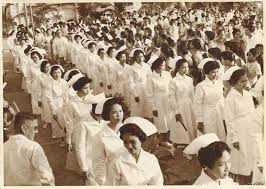
After the War: The Exchange Visitor Program
After World War II, American hospitals faced a severe nursing shortage. The war had expanded the healthcare system dramatically, and the postwar boom had increased demand for medical services across the country. American women were entering the workforce in new ways — the traditional pipeline of women into nursing was drying up as other professions opened.
The solution the United States reached for was the Philippines.
In 1948, the Exchange Visitor Program (EVP) was established, allowing foreign professionals — including nurses — to come to the United States on a temporary basis for training and cultural exchange. The program was, in theory, designed to benefit the sending countries: Filipino nurses would come, learn advanced techniques, and return home to improve Philippine healthcare.
In practice, it worked differently. Filipino nurses who arrived under the EVP found themselves working the hardest shifts in the most understaffed wards of American hospitals, often paid less than their American counterparts, assigned to the most undesirable duties, and confronting the reality that "exchange" was a polite word for "labor supply." Many did not go home. They stayed, found ways to extend their visas, and built lives in America — often bringing family members behind them.
The slogan that recruitment agencies used to attract Filipino nurses to the program said everything you needed to know: "Your cap is your passport."
"Your cap is your passport."
— Recruitment slogan used to attract Filipino nurses to the U.S. Exchange Visitor Program, 1950s–1960s
1965: The Year Everything Changed
Two laws passed in 1965 would together transform Filipino America — and American healthcare — forever.
The first was the Immigration and Nationality Act of 1965, which abolished the national origins quota system that had essentially barred Asian immigration for decades. In its place, a preference system prioritized skilled workers in areas of labor shortage. Nursing was on that list. For the first time, Filipino nurses could petition for permanent residency — and bring their families with them.
The second was the creation of Medicare and Medicaid, which overnight extended health coverage to millions of Americans who had previously been uninsured. In 1966 alone, 19 million Americans enrolled in Medicare. The demand for healthcare workers — nurses especially — exploded. American hospitals, already stretched thin, began actively recruiting abroad.
The Philippines was the obvious destination. Decades of American colonial education had produced a workforce of English-speaking, Western-trained nurses who were familiar with American medical systems and, critically, who had been raised in a culture that oriented toward the United States as the destination of aspiration. By 1967, the Philippines had become the global leader in exporting nurses to the United States.
Between 1966 and 1985, more than 25,000 Filipino nurses immigrated to the United States. In New York City hospitals by the 1980s, nearly one in five nurses was from the Philippines.
The 1965 Double Trigger
Immigration and Nationality Act (1965): Eliminated racial quotas in immigration. Created a preference for skilled workers in shortage areas. Filipino nurses could now immigrate permanently and bring families.
Medicare and Medicaid (1965): Expanded healthcare coverage to 19 million Americans overnight. Hospitals needed far more nurses than the domestic supply could provide.
The Women's Movement: As American women gained access to careers beyond nursing and teaching, the traditional pipeline of domestic nurses thinned further. The gap widened.
The Philippine side: Post-independence economic stagnation, peso devaluation, and high unemployment made U.S. wages extraordinarily attractive. A Filipino nurse in the Philippines in the 1970s would have to work nearly 12 years to earn what a Filipino nurse made in one year in the U.S.
Marcos government policy: President Ferdinand Marcos explicitly encouraged nurse emigration as a strategy to reduce unemployment and generate remittance income for the Philippine economy — formalizing what became a decades-long government-sponsored labor export program.

The Backbone Nobody Talked About
By the 1970s and 1980s, Filipino nurses were not a supplement to the American healthcare system. They were its infrastructure. They filled wards in New York, Los Angeles, Chicago, and San Francisco. They worked the night shifts in intensive care units. They cared for patients with the most complex needs in the most demanding settings.
And they did this while navigating a healthcare system that did not always welcome them. Research documented systematic patterns of discrimination: less desirable shifts, underemployment relative to their qualifications, lower wages compared to white American nurses doing equivalent work, and xenophobic hostility from some professional organizations that viewed Filipino nurses as a threat to domestic employment.
The most notorious example came in 1975, when two Filipino nurses —
Filipina Narciso and Leonora Perez — were accused of poisoning patients at a Veterans Administration hospital in Ann Arbor, Michigan. The charges were ultimately dropped and both women acquitted, but the prosecution subjected them to a nationally publicized ordeal in which, as Choy documents, the nurses were portrayed as "dark, dangerous, and conspiratorial Filipino natives with the propensity to harm their American patients." The case was a vivid illustration of how quickly Filipino nurses could be transformed — in the American imagination — from indispensable caregivers to suspects.
Through it all, Filipino nurses kept working. During the AIDS crisis of the 1980s, when many American-born healthcare workers refused to treat patients with HIV/AIDS due to stigma and fear, Filipino nurses disproportionately stepped in. They took the wards others abandoned. They cared for patients whom the healthcare system had largely written off. The Filipino population in the United States doubled between 1980 and 1990, in part because of the Nursing Relief Act of 1989, which granted special immigrant status to nurses in recognition of their indispensable role during the AIDS epidemic.
"Without Filipino nurses, the U.S. healthcare system would have been paralyzed."
— Catherine Ceniza Choy, historian and author of Empire of Care, UC Berkeley
2020: COVID-19 and the Bill That Came Due
In early 2020, as COVID-19 spread across the United States, the country's healthcare system was tested as it had not been since the 1918 flu pandemic. Hospitals were overwhelmed. ICUs reached capacity. Personal protective equipment was scarce. And on the frontlines — in the intensive care units, in the emergency rooms, in the long-term care facilities — Filipino nurses were there, as they had always been.
They died at rates that shocked the country when the data finally surfaced.
Filipino Americans make up approximately 4% of the registered nursing workforce in the United States. According to data from National Nurses United, the largest nurses' union in the country, Filipino nurses accounted for 31.5% of all U.S. nurse deaths from COVID-19 in the early months of the pandemic. Later analyses confirmed the pattern: in some periods and some states, the proportion was even higher.
In California — where Filipino Americans make up about a quarter of the Asian American population — Filipino healthcare workers accounted for 29.5% of COVID-19 deaths among Asian Americans during peak pandemic periods. Among California's Filipino healthcare workers, the death-to-case ratio was nearly 16 times more severe than that of non-Latino white healthcare workers.
Researchers identified several interconnected reasons. Filipino nurses were disproportionately working in the highest-risk settings: ICUs, emergency rooms, long-term care facilities. They were more likely to work overnight shifts with the sickest patients. They faced shortages of protective equipment and, in some cases, felt cultural pressure not to complain or advocate for themselves — a dynamic that some researchers traced directly to the colonial legacy of working in systems designed by and for others. Many Filipino nurses also lived in multigenerational households, meaning that bringing COVID-19 home carried consequences for parents, grandparents, and vulnerable family members who could not isolate.
And they kept going to work anyway.
A group of activists and researchers created Kanlungan — the Tagalog word for "refuge" or "shelter" — as a crowdsourced memorial to Filipino healthcare workers who died during the pandemic. It became a vital data source when official tracking systems failed to disaggregate deaths by ethnicity. The people behind Kanlungan spent their days searching obituaries, social media posts, and news clippings for Filipino names.
"Three times as many Filipino healthcare workers have died here in the U.S. than in the Philippines. So right away, we know that something is wrong."
— Jollene Levid, co-founder of the Kanlungan memorial project
The Full Circle: What the Numbers Really Mean
The COVID-19 death statistics for Filipino nurses are not a coincidence. They are the product of a system that was designed, 120 years ago, to produce a specific kind of worker for a specific kind of role — and that has never fully reckoned with what it took from the Philippines, or what it owes to the people it recruited.
The United States built nursing schools in the Philippines to serve American medical needs. It created immigration pathways that made it easy for Filipino nurses to come — but difficult for them to organize, advocate, or leave once they were embedded in an underpaid and overworked system. It deployed them to the most hazardous wards during the AIDS crisis. It sent them to the ICUs during COVID-19. It relied on their cultural values of care, service, and self-sacrifice — bayanihan, the collective spirit of helping others — while providing inadequate PPE and insufficient pay.
As scholar Jcenine Agustin has written, the story of Filipino nurses in America is not a story of grateful immigrants who found opportunity. It is a story of a labor system designed to extract care from a colonized people — and to render that extraction invisible by framing it as natural Filipino character rather than the product of deliberate policy.
Filipino nurses are not naturally more caring than other people. They are people who were trained in a system built by a colonizer, recruited by that same system decades later, deployed to the hardest wards, and celebrated in rhetoric while being underprotected in practice.
That is the story behind the statistics. That is the story behind every Filipino nurse who has ever taken care of a patient in an American hospital.
Honor Every Filipino Healer
This history belongs in every Filipino American home — in conversations, in classrooms, and in the everyday act of wearing your roots. At UGAT, we design for the community that built this country's healthcare system and deserves to have that recognized.
What Recognition Actually Looks Like
In 2025, the television show The Pitt — a medical drama on HBO Max — featured a Filipino American nurse in a central role and explicitly engaged with the history of Filipino nurses in American healthcare. For many Filipino Americans, it was the first time they had seen this history reflected in mainstream popular culture.
In 2024, the documentary Nurse Unseen, directed by Michele Josue, spotlighted the role of Filipino nurses in America — their history, the COVID-19 toll, the mental health crisis, the burnout. Josue described it as a deeply personal project: "I realized it was a much more emotional project than I had anticipated. A lot of this project was me just really coming to terms with my Filipino identity, seeing how my personal family history was rooted in all this broader history."
These cultural moments matter. But recognition is not the same as justice. Real recognition of Filipino nurses' contribution to American healthcare would mean data disaggregated by Asian subgroup so that Filipino health disparities are visible and addressable. It would mean PPE and working conditions that match the risk. It would mean wages and professional advancement opportunities commensurate with experience and training. It would mean an honest reckoning — in schools, in hospitals, and in public discourse — with the colonial history that created the Filipino nursing diaspora in the first place.
That reckoning has barely begun. But it starts with knowing the story.
Your Cap Is Not Your Passport
Filipino nurses did not come to America because it was their natural destiny. They came because a colonial system trained them for American hospitals, because immigration law created pathways specifically for healthcare workers, because economic conditions in the Philippines — shaped in part by that same colonial history — made the choice rational. They came because recruiters told them their nursing cap was their passport. They came because their families needed the remittances. They came because the dream of America had been planted in them by decades of American education.
And once here, they cared for everyone. They cared for AIDS patients when others would not. They stayed through the COVID pandemic when the risk was greatest. They kept working through grief, through fear, through burnout, through the knowledge that three of their own were dying for every one who died back home.
They are not a workforce. They are people. They are mothers, daughters, fathers, sons, community members, artists, organizers, and yes, nurses — skilled, dedicated, and deserving of a history that tells the truth about how they got here and what they have given.
If you have a Filipino nurse in your family — or if you are one — this history is yours. It belongs to you. It has been here, waiting to be claimed, for over a hundred years.
Know it. Share it. Wear it.
Is there a Filipino nurse in your family? Were you or someone you love affected by COVID-19 in the healthcare community? This story is shared by hundreds of thousands of Filipino American families — tell us yours in the comments. Every name and every story deserves to be remembered.
📖 FAHM Series: "Mga Bayani ng Kasaysayan" — The Full Timeline
Part of UGAT's Filipino American History Month series, ordered as history happened.
Know Your Roots
Get Filipino heritage stories, new collection drops, and cultural deep-dives from UGAT — not just in October.
Shop the Ugat Jersey Collection
Wear the history. Our mesh jerseys put Filipino heroes and Baybayin front and center, $72 each.
Kalayaan Jersey — Maroon mesh with a hand-drawn U honoring the heroes of Philippine independence. KALAYAAN 98 on the back. Shop now →
Pilipinas Jersey — Navy mesh with Lapu-Lapu and the warriors of Mactan, Baybayin across the shoulders and PILIPINAS 63 on the back. Shop now →
Delano Manong Jersey — Brown mesh honoring the Filipino farmworkers who started the 1965 Delano Grape Strike. Shop now →
See all jerseys in the Ugat shop.
Comments